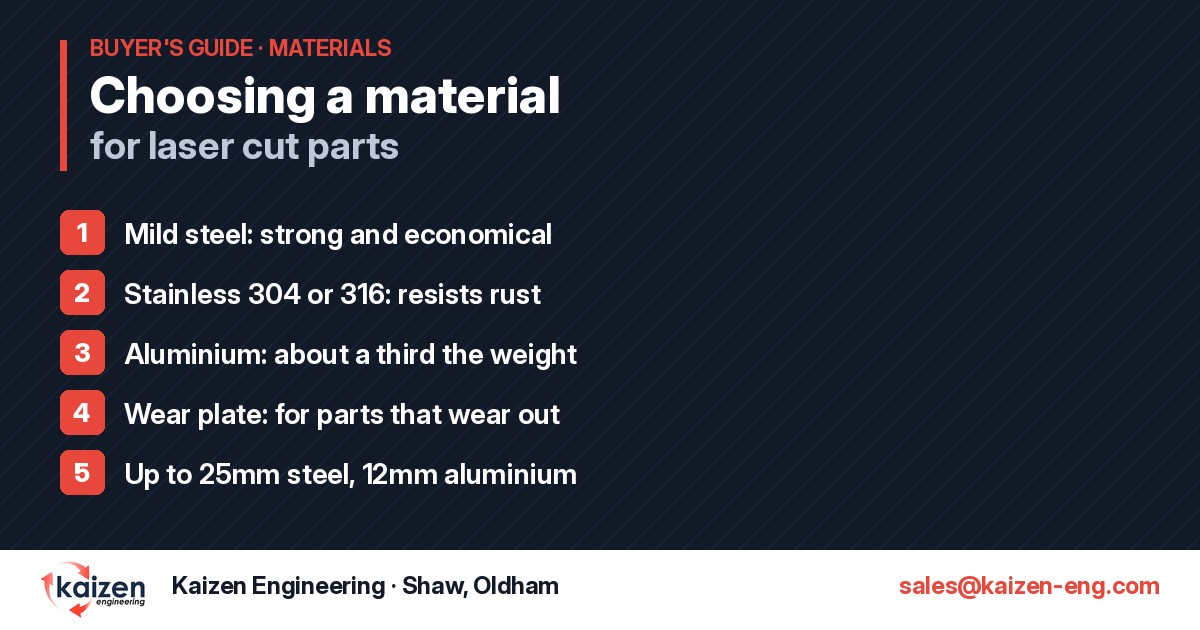
Choosing the material is one of the first decisions on any laser cut part, and it drives the price, the lead time and how well the part does its job. Most of the parts we cut at Kaizen are in one of four materials: mild steel, stainless steel, aluminium or wear plate. This guide explains what each is good at, where it falls short, and what to tell us when you send a drawing, whether you need one bracket or a regular production run.
Mild steel is the workhorse of general engineering. It’s strong, easy to cut, fold and weld, and it’s usually the most economical option per part. Structural grades such as S275 and S355 are common for brackets, base plates, guards, frames and fabricated assemblies.
Its weakness is corrosion. Bare mild steel will rust, so parts that live outdoors or in damp conditions normally need a finish such as painting, powder coating or galvanising. If a part is going inside a machine or a dry building, a light oil or primer is often enough.
Choose mild steel when: strength and cost matter most, the part will be painted or coated, or it’s going into a welded fabrication.
Stainless steel contains chromium, which forms a thin protective layer on the surface and stops it rusting in normal conditions. It looks good without a coating and is easy to keep clean, which is why it’s used for food and drink equipment, signage, marine fittings, architectural details and parts that need to stay presentable.
The two grades buyers ask about most are 304 and 316. Grade 304 suits most indoor and general outdoor use. Grade 316 contains molybdenum, which gives better resistance to salt, chlorides and harsher chemicals, so it’s the usual pick for coastal, marine and some process environments. Stainless costs more than mild steel, so it’s worth specifying only where its corrosion resistance or appearance earns its keep.
Choose stainless when: the part can’t rust, can’t be painted, needs to look clean, or will be washed down regularly.
Aluminium weighs roughly a third as much as steel for the same size of part, and it resists corrosion well without a coating. That makes it a good fit for covers, panels, enclosures, vehicle and trailer parts, and anything that has to be lifted or moved often.
It isn’t as strong or as stiff as steel, so an aluminium part may need to be thicker, or folded to add stiffness, to do the same job. Different alloys behave differently when bent and welded, so if your part will be folded or welded, tell us what it’s for and we’ll check the grade is suitable before we cut.
Choose aluminium when: weight matters, the part needs to resist corrosion without a coating, and the loads are moderate.
Wear plate is a hardened, high-strength steel made to stand up to abrasion: material sliding, scraping or impacting against the surface. It’s used for bucket and hopper liners, skip and truck body wear strips, chute liners, shredder and recycling machinery parts, and any part that keeps wearing out in mild steel.
It costs more than mild steel and needs the right approach to cut, bend and weld, but on the right job it can last far longer, which means less downtime and fewer replacements. You can read more about the wear parts we make and the SSAB steels we work with.
Not sure whether wear plate is worth the extra cost? Our guide to Hardox 450 vs mild steel for wear parts explains when it pays for itself.
Choose wear plate when: a part is wearing out quickly and the cost of downtime or replacement outweighs the extra material cost.
Thickness affects strength, weight, cost and how tightly a part can be bent. Our laser cutting service handles mild steel and stainless steel up to 25mm thick and aluminium up to 12mm thick. If you’re not sure what thickness you need, tell us what the part does and what it carries, and we’ll give you our view. Going one size thinner can save money, but not if the part then bends or cracks in use.
The material choice should take account of the whole job, not just the cut:
| Material | Main strength | Watch out for | Typical uses |
|---|---|---|---|
| Mild steel | Strong, economical, easy to fold and weld | Rusts unless coated | Brackets, base plates, frames, guards |
| Stainless steel | Corrosion-resistant, clean finish | Higher material cost | Food equipment, signage, marine and outdoor parts |
| Aluminium | Light, resists corrosion | Less strong and stiff than steel | Covers, panels, enclosures, vehicle parts |
| Wear plate | Resists abrasion, lasts longer in harsh use | Higher cost, needs the right processing | Liners, wear strips, bucket and shredder parts |
When you ask for a quote, tell us the material and grade if you know them. If you don’t, tell us what the part is for and where it will be used, and we’ll suggest the most suitable and cost-effective option. A drawing (DXF, DWG, STEP, IGES or PDF), the thickness, the quantity and any folding, welding or finishing you need will let us give you an accurate price quickly. Our guide to sending a drawing for a laser cutting quote has a full checklist, or you can use our request a quote checklist.
Weighing up how the part should be cut as well? See our guide to laser cutting vs plasma cutting.
Whether you’re a large manufacturer or a small workshop, get in touch with Kaizen Engineering in Shaw, Oldham. Call 01706 847 172 or email your drawings to sales@kaizen-eng.com and we’ll help you choose the right material for the job.
Kaizen Engineering, Thomas Street, Shaw, Oldham OL2 8PG.
Mild steel is usually the most economical per part. If the part needs protecting from rust, include the cost of a coating when comparing it with stainless or aluminium.
Grade 304 suits most indoor and general outdoor parts. Grade 316 is the better choice near the sea, around salt or chlorides, or in harsher chemical environments.
Yes. Tell us what the part does, what loads it takes and where it will be used, and we’ll recommend a material and thickness.
No. We supply cut, folded and fabricated parts made to your drawing, not full sheets or plates of material.
Hardox® is a registered trademark of SSAB.
