If you buy cut steel parts, you’ve probably been quoted for both laser and plasma at some point. Both processes profile sheet and plate straight from a drawing, and both have their place. The right choice depends on the thickness of the material, how accurate the part needs to be, what happens to it after cutting, and how many you need. This guide sets out the main differences in plain terms, so you can ask for the right process when you send a drawing for a quote.
Laser cutting uses a tightly focused beam of light to melt the steel along the cut path, with an assist gas blowing the molten metal clear. A modern fibre laser, like the 8kW Trumpf fibre laser in our Shaw cutting shop, produces a very fine beam that gives a narrow cut and a clean, consistent edge.
Plasma cutting passes an electric arc through a jet of gas, creating a very hot plasma stream that melts and blows through the metal. It’s a fast, well-proven process, especially on thicker carbon steel plate, but the cut is wider and the heat input is greater than with a laser.
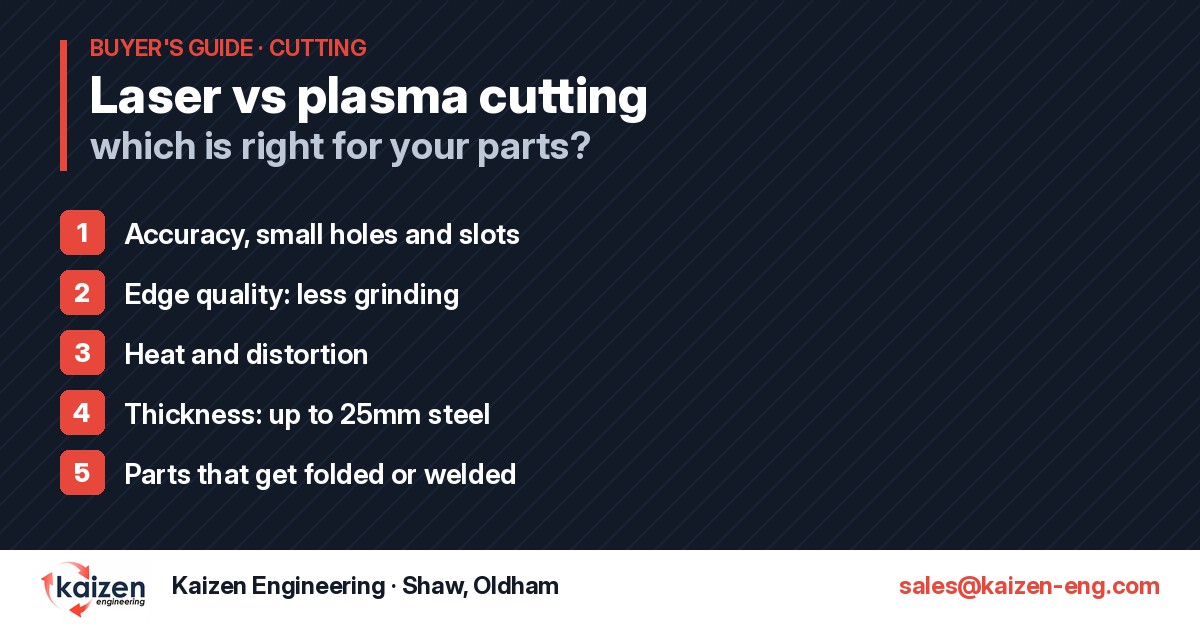
This is where laser cutting usually wins. The narrow beam means small holes, slots and fine details come out sharp and true to the drawing, and the edge is clean enough that many parts can go straight to folding, welding or assembly without grinding. Plasma edges are generally rougher, with more bevel on the cut face and more dross to clean off. That’s fine for some structural work, but it can add finishing time and cost on parts that need to fit together precisely.
Laser cutting puts less heat into the part, so the heat-affected zone along the edge is small and thin sheet is less likely to distort. That matters for parts that will be folded on a press brake, where a flat, consistent blank gives repeatable bends, and for parts that will be welded into a fabrication. Plasma’s higher heat input can cause more distortion on thinner material.
Laser cutting covers most of the sheet and plate thicknesses that general engineering buyers need. At Kaizen we laser cut mild steel and stainless steel up to 25mm thick and aluminium up to 12mm thick, and we keep a Trumpf CO2 laser alongside the fibre for thicker plate work. Plasma comes into its own on heavy plate beyond what lasers typically handle, where edge finish matters less than getting through the material.
Fibre lasers are well suited to reflective metals, so stainless and aluminium sheet can be cut with a high-quality edge. If your parts are visible on a finished product, such as stainless panels, covers or brackets, a laser cut edge usually needs far less cleaning up.
Abrasion-resistant wear plate and quenched and tempered steels are sensitive to heat, and too much heat along the edge can soften the material locally. A laser’s lower heat input helps keep the properties of the plate close to the cut edge. If you’re buying wear parts, tell us the grade and what the part does, and we’ll advise on cutting and any follow-on bending or welding. Our SSAB steels and wear parts pages have more detail.
Choosing between wear plate and mild steel? Read our guide to Hardox 450 vs mild steel for wear parts.
Neither process needs tooling, so both are cost effective for one-offs and prototypes as well as batches. On sheet and most plate work a fibre laser is very fast, and tight nesting across the sheet keeps material waste down, which helps the price per part. The cheapest quote isn’t always the cheapest job, though: if a plasma cut part needs grinding or reworking before it can be folded or welded, that time has to be paid for somewhere.
Because our laser cutting shop sits alongside our CNC press braking, fabrication and assembly departments, parts can go from flat sheet to finished assembly without moving between suppliers. Whether you’re a large manufacturer needing scheduled batches or a small business after a handful of parts, we’ll work to your drawing and your timescale.
To get a price, email your drawing (DXF, DWG, STEP, IGES or PDF) to sales@kaizen-eng.com with the material, thickness, quantity and the date you need the parts. You can also call us on 01706 847 172 or use our contact form. Not sure what to include? See our guide on how to send a drawing for a laser cutting quote, or our request a quote checklist.
Kaizen Engineering, Thomas Street, Shaw, Oldham OL2 8PG.
Generally, yes. A laser’s narrow beam gives a finer cut, sharper detail and a cleaner edge, which is why it’s the usual choice for precision parts and parts that will be folded or welded.
We laser cut mild steel and stainless steel up to 25mm thick and aluminium up to 12mm thick, with a Trumpf CO2 laser available for thicker plate work.
Yes. Laser cutting needs no tooling, so single prototypes and short runs stay cost effective, and once a part is programmed it can be repeated to the same standard.
Yes. We laser cut abrasion-resistant wear plate and high-strength steels. Tell us the grade, thickness and application and we’ll quote the part, plus any folding or welding it needs.
Hardox® is a registered trademark of SSAB. Trumpf is a trademark of TRUMPF.
