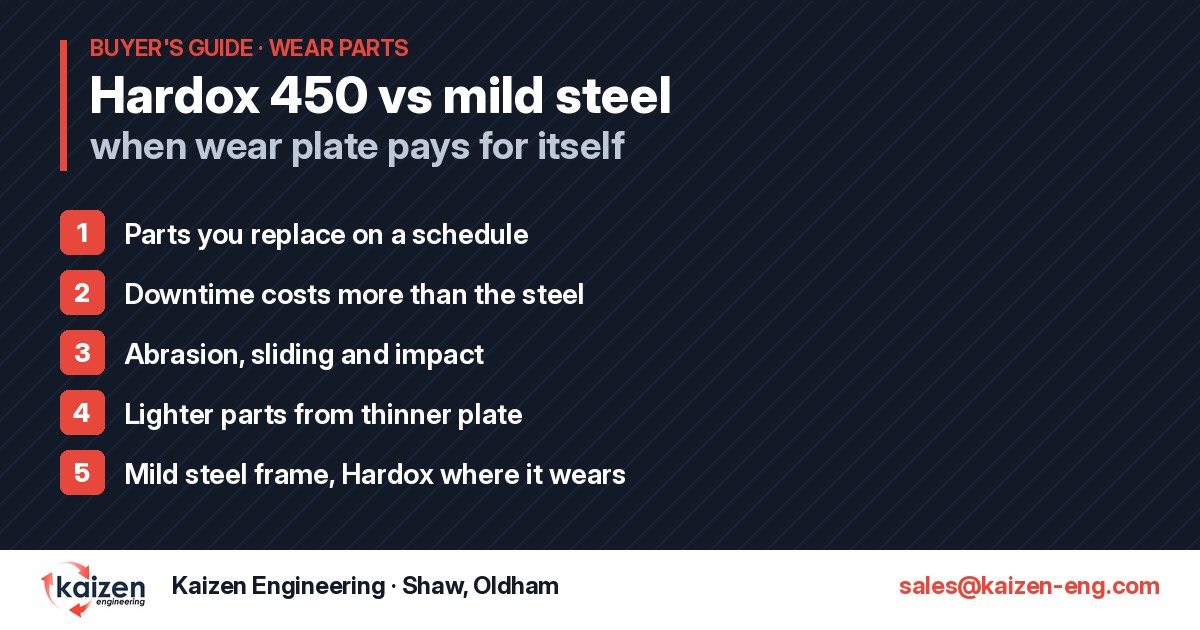
Hardox 450 vs mild steel wear parts guide, Kaizen Engineering, Oldham

If a part keeps wearing out, the usual fix is to make it thicker. Often the better fix is to make it from a harder steel. This guide explains when Hardox® 450 wear plate is worth it over standard mild steel, what changes when you design with it, and what to send us for a quote. It’s written for buyers and engineers at large manufacturers and for small firms, farms and contractors alike.

What is Hardox 450?

Hardox 450 is an abrasion-resistant steel made by SSAB. According to SSAB’s published datasheet, it has a nominal hardness of 450 HBW (Brinell), with a hardness range of 425–475 HBW for plate from 3.2 to 80 mm thick, and a typical (not guaranteed) yield strength of around 1,250 MPa. It is through-hardened, so the inside of the plate is hard too, not just the surface. SSAB states the minimum core hardness is 90% of the guaranteed minimum hardness.

Standard structural mild steels such as S275 and S355 are much softer. They’re excellent for frames, brackets and general fabrication, but where material slides, scrapes, tumbles or impacts against a surface every day, they wear away far faster than a hardened wear plate.

When Hardox is worth it

  • Parts you replace regularly. Liners, wear strips, scraper blades, cutting edges and chute plates that you change on a schedule are the classic case.
  • Downtime costs more than steel. If changing a part means stopping a line, a shredder or a machine in the field, a longer-lasting part usually pays back quickly.
  • Weight matters. SSAB notes that the extra hardness can let you use a thinner plate for the same job, which means lighter equipment and less load on the parts around it.
  • Dents and abrasion. Buckets, hoppers, skips and trailer floors take both. Hardox 450 is designed to resist both better than softer grades.

When mild steel is still the right choice

  • Structural frames, brackets, guards and enclosures that don’t see wear.
  • Parts that need heavy forming or tight bends. Hardox can be bent, but it needs larger bend radii than mild steel.
  • One-off prototypes where you’re still proving the design.

Many jobs use both: a mild steel structure with bolt-on or welded Hardox wear parts where the wear actually happens. That keeps cost down and makes the worn parts quick to swap.

Designing with Hardox: what changes

  • Cut it, don’t machine it. Laser cutting is the easiest way to get accurate Hardox profiles, holes and slots. Drilling and machining hardened plate is slow and hard on tooling, so put the holes in the cutting file where you can.
  • Bending. Allow a generous inside radius and tell us the bend detail on the drawing. We’ll check it against the plate thickness before we quote.
  • Welding. Hardox is weldable. If your part is part of a fabrication, we can weld it into the assembly as part of our fabrication work, such as welded chute sections, hoppers and guards.
  • Bolt-on wear parts. Countersunk holes and replaceable strips make future changes quicker and cheaper.

Common Hardox parts we make

  • Wear strips, liners and chute plates
  • Scraper blades and cutting edges
  • Shredder and recycling machine wear parts
  • Agricultural wear parts, such as subsoiler and cultivator plates
  • Bucket, hopper and skip wear plates

See our recycling and wear parts page for more, and our SSAB steels page for the other high-strength grades we cut to order.

What to send for a Hardox quote

  1. A drawing or file of the part (we accept all engineering file formats, such as DXF, DWG, STEP, IGES and PDF), or a dimensioned sketch.
  2. The thickness you need, or what the part does and what it currently lasts, so we can suggest one.
  3. The quantity, and whether it’s a repeat part.
  4. Any bends, countersinks or welding.
  5. Your delivery postcode, or whether you’ll collect from Shaw, Oldham.

Not sure your file is ready? Our guide on how to send a drawing for a laser cutting quote covers the simple fixes, and our request a quote checklist lists everything we need to price a job.

Email your drawing to sales@kaizen-eng.com, call us on 01706 847 172, or use our contact form. We aim to come back with a quote the same day. We cut Hardox parts to order, so we can make one wear plate or a full production run.

Kaizen Engineering, Thomas Street, Shaw, Oldham OL2 8PG.

Frequently asked questions

Is Hardox the same as “wear plate”?

Hardox is SSAB’s brand of abrasion-resistant steel. “Wear plate” is the general term, and other brands exist. If your drawing says wear plate or quotes a hardness, tell us and we’ll confirm what we’re quoting.

Can you laser cut Hardox?

Yes. Laser cutting is how we make most of our Hardox parts, including holes and slots, which saves drilling hardened plate afterwards. See our laser cutting service.

Can Hardox be bent?

Yes, with a larger radius than mild steel. Send us the bend detail and we’ll confirm it on our press brake before quoting.

Do you sell full sheets of Hardox?

No. We make finished parts cut to your drawing, not full plates.

Hardox® is a registered trademark of SSAB.

Share this article

News Filters

Use our handy news filters to find what you’re looking for quickly. Search by keyword, category or tag.

Filter blog

Contact us

Thomas Street
Shaw
Oldham
OL28PG

01706 847 172

Call us today on 01706 847 172 or contact us here