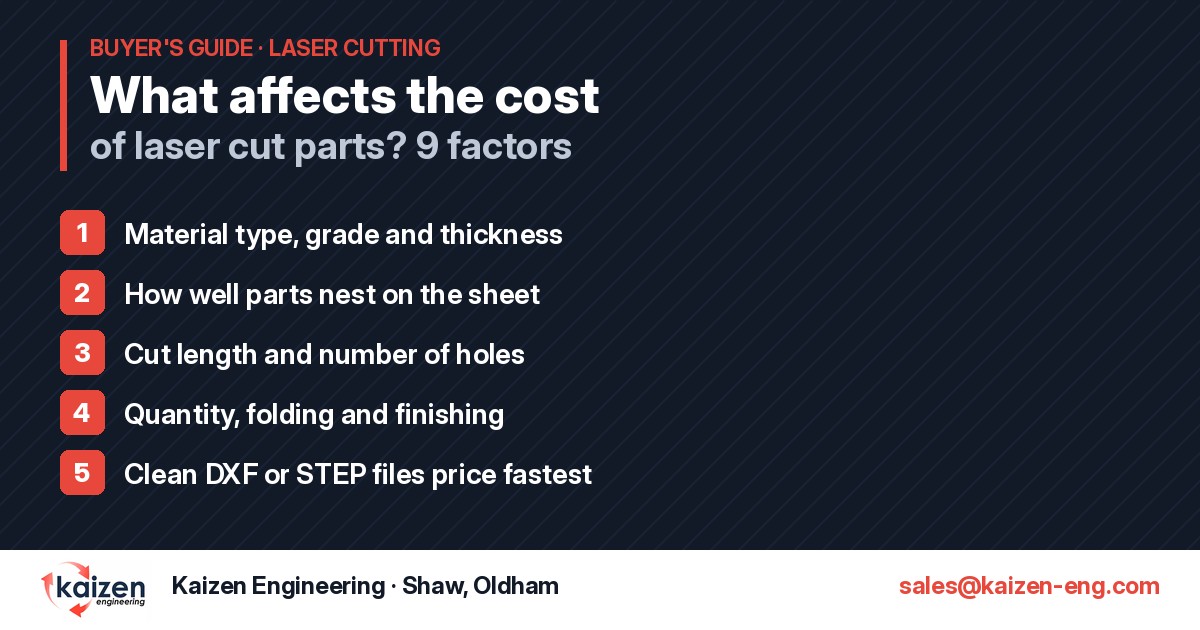
When you send a drawing for a laser cutting quote, the price that comes back isn’t plucked from the air. It’s built from a handful of things that every cutting shop has to account for. Knowing what they are helps you get a fair price, compare quotes properly and, often, take cost out of a part before it’s ever cut. This plain-English guide walks through the main factors, whether you’re buying ten brackets or ten thousand.
The material is usually the biggest single part of the price. Mild steel is the cheapest everyday option, stainless costs more, and aluminium and wear plate sit higher again per kilo. Within each family the grade matters too: S355 costs a little more than S275, and 316 stainless more than 304. If a part doesn’t truly need the more expensive grade, saying so on the drawing can save money. Our guide to choosing a material for laser cut parts covers the trade-offs.
Thicker plate weighs more, so the material costs more, and it also cuts more slowly. If a thinner gauge plus a fold or a stiffening flange will do the same job, it’s often the cheaper route.
Parts are nested together on a full sheet to use as much of it as possible. Shapes that tessellate well, such as rectangles and plates with straight edges, waste less material than awkward or curved shapes. Very large parts, or odd shapes that leave big gaps, take a bigger share of the sheet, and that shows up in the price.
The laser charges by time, and time comes mainly from two things: the total length of every cut line, and the number of pierces (each hole or internal cut-out starts with one). A plain plate is quick. The same plate with dozens of small holes, slots and fine detail takes much longer. If holes are only there for clearance, fewer, larger ones are often cheaper than lots of small ones.
Every job has some fixed work before cutting starts: checking the drawing, programming and setting up. On a single part, that’s spread over one piece; on a batch of hundreds it’s spread very thinly. That’s why the price per part drops as quantities rise. If a part repeats, tell us the likely annual usage, as it helps us plan stock and price sensibly.
Folding, welding, tapping, countersinking, assembly and kitting all add time, but doing them under one roof usually costs less than sending parts between several suppliers. Each fold on the press brake is a separate setup and handling step, so parts with fewer, well-planned bends are cheaper to make. See our tips on designing parts for press braking.
Laser cut edges are clean, but some parts need deburring, a brushed or polished finish on stainless, or protective film left on. If your parts go for painting or powder coating, mention it, because it can change how they’re prepared and packed.
A clear, accurate drawing saves time at both ends. Files that need redrawing, missing dimensions or unclear material callouts all slow down quoting and can add cost. A clean DXF, DWG, STEP or IGES file (or a dimensioned PDF) with material, thickness and quantity stated is the quickest way to an accurate price. Our guide on how to send a drawing for a laser cutting quote explains what to include, or use our request a quote checklist.
Delivery is priced on size, weight and distance, so collecting your own parts can save money if you’re local to Shaw, Oldham. Urgent jobs that have to jump the queue may also cost more than work that can fit into the normal schedule, so give as much notice as you can.
Kaizen Engineering cuts mild steel, stainless, aluminium and wear plate on our 8kW Trumpf fibre laser in Shaw, Oldham, with press braking, fabrication and assembly in-house. Email your drawings to sales@kaizen-eng.com or ring 01706 847 172, and we’ll come back with a clear price. You can also request a quote online or contact us.
Kaizen Engineering, Thomas Street, Shaw, Oldham OL2 8PG.
More reading: browse all our laser cutting and sheet metal guides.
Checking the drawing, programming and setting up take roughly the same time whether you order one part or a hundred. On a one-off, all of that sits on a single piece.
Yes. We cut everything from one-off prototypes to production runs, for large manufacturers and small workshops alike.
Yes. If we can see a way to save material, cutting time or a fold without affecting how the part works, we’ll mention it when we quote.
No. We supply material as part of finished, cut parts, not as full sheets or plates.
