A folded part is only as good as the flat blank it starts from. Most of the problems we see with bent sheet metal parts aren’t caused by the press brake at all; they’re baked in at the drawing stage, with a hole too close to a bend, a flange too short to grip, or a bend line that runs straight through a slot. This guide covers the handful of design points that make the biggest difference, so your parts come off the brake right first time and your quote comes back quicker.
At Kaizen in Shaw, Oldham, we laser cut the blanks on our 8kW Trumpf fibre laser and fold them in-house on our 250-tonne Bystronic press brake, which takes parts up to 4m long. Because cutting and bending happen under one roof, we can check a flat pattern against the bends before anything is cut. The points below are general good practice; every job is different, so if you’re unsure about any of them, send us the drawing and we’ll tell you before you commit.
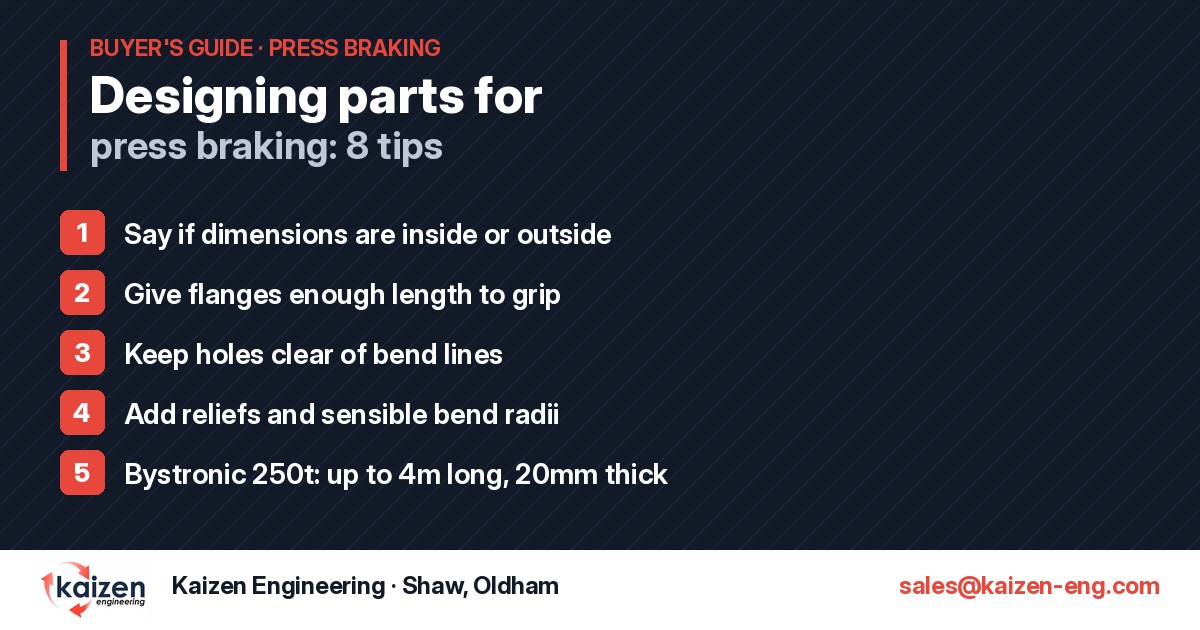
When a part is bent, the material stretches on the outside of the bend and compresses on the inside. That means a flange can be measured to the inside face, the outside face or the centre line, and each gives a different flat blank. The single most useful thing on a bent-part drawing is a clear note of which faces the dimensions are taken from, and which dimensions really matter to you.
If you send a 3D model, we can unfold it ourselves. If you send a 2D drawing, mark the critical dimensions (the ones that must fit something else) so we can hold those and let the less important ones take up the difference.
A flange needs to be long enough to sit across the bottom tool while it’s being bent. If it’s too short, it slips into the die and the bend comes out wrong or can’t be made at all. The minimum flange length goes up with material thickness, because thicker material needs a wider die opening.
As a rough rule of thumb, the shortest flange that can be bent reliably is a few times the material thickness, and it gets longer as the plate gets thicker. If your design needs a very short leg, tell us early. There’s often a workaround, such as bending a longer flange and trimming it, or changing the order of operations.
Holes, slots and cut-outs that sit too close to a bend will stretch into ovals or tear as the material flows around the bend. A common guide is to keep features at least two to three times the material thickness, plus the inside bend radius, away from the bend line.
If a hole has to be close to a bend, for example to line up with a fixing after folding, let us know which hole and why. Sometimes the answer is to cut it slightly oversize, or to add a small relief so the hole holds its shape.
Where a bend runs into an uncut edge or a corner, the material has nowhere to go and can tear or bulge. A small relief cut (a narrow slot or a rounded notch at the end of the bend line) gives it room to move. They’re quick to add to the laser profile and they make for cleaner corners, especially on boxes, trays and enclosures.
The inside radius of a bend is set mainly by the tooling and the material thickness. Asking for a radius much tighter than the thickness can crack harder materials, while a very large radius may need special tooling. For most mild steel parts, an inside radius roughly equal to the thickness is a safe starting point.
Harder and higher-strength materials, including wear plate, generally need bigger radii and more force than mild steel, and they spring back more after bending. If you’re specifying a wear-resistant or high-strength grade for a bent part, talk to us first so we can check the bend is achievable.
Rolled plate has a grain direction. Bending across the grain is usually kinder to the material than bending along it, particularly on thicker or harder grades. You don’t always need to specify it, but if a part is critical, mention it and we’ll nest the blanks to suit.
Parts with lots of bends, deep channels or closed-in shapes can trap themselves: once some flanges are folded, there may not be room for the tooling to reach the next bend. It’s worth sketching the order in which the bends would be made. If a shape can’t be folded in one piece, it can often be split into two parts and welded, which is something we can do as part of a fabrication job.
Each bend adds a small amount of variation, and that adds up across a part with several folds. Tight tolerances on every dimension push up the cost. Put the tight tolerances where they matter, on fixing holes, mating faces and overall fit, and leave general tolerances everywhere else.
Our guide on how to send a drawing for a laser cutting quote covers file types in more detail, or you can use our request a quote checklist.
Many brackets, cleats and short angle or channel sections don’t need to start life as rolled section. We often make angle-type parts by laser cutting a flat blank and folding it, which means holes, slots and notches can be cut in the same operation and the part comes out exactly to your drawing. If you’re not sure which route suits your part, send it over and we’ll suggest the most cost-effective option.
Still deciding on the material? See our guide to choosing a material for laser cut parts.
Our 250-tonne Bystronic press brake takes parts up to 4m long. For anything larger, get in touch and we’ll talk through the options.
No. Send us a 3D model or a clear drawing of the finished part and we’ll produce the flat blank, allowing for the bends.
Yes. We fold everything from one-off prototypes to production runs, for large manufacturers and small workshops alike.
No. We supply finished cut and folded parts made to your drawing, not full sheets or plates.
Got a bent part you’d like checked or quoted? See our press braking and laser cutting services, email sales@kaizen-eng.com, call 01706 847 172, or contact us.
Kaizen Engineering, Thomas Street, Shaw, Oldham OL2 8PG.
